How much is title insurance? Costs, requirements, and savings tips
Contributed by Sarah Henseler
Updated Aug 4, 2026
•10-minute read


When you buy a house, your legal right to it comes down to the title. Title problems can have expensive consequences, and the last thing you want is someone else coming forward claiming ownership of your new home, whether that's a contractor with an unpaid lien or a long-lost heir who says they still have a stake in the property.
Title insurance exists to protect you from exactly those kinds of scenarios. It's a one-time policy, generally costing between 0.5% and 1% of your loan amount, or a flat rate set by your state. The costs cover protection for your lender, and optionally your own ownership rights, if a hidden title problem comes up after you've already closed.
Key takeaways:
- Title insurance protects against past problems with your home's legal ownership – like an old lien, a disputed will, or fraud and forgery – that a title search might miss.
- Title insurance comes in two forms: a lender's policy, which is almost always required, and an owner's policy, which is optional but highly recommended.
- Combined, both title insurance policies typically cost between 0.5% and 1% of your loan amount, paid once at closing rather than as a recurring premium.
How much is title insurance?
Title insurance is generally priced according to the policy amount, but the calculation varies by state. Premiums can follow a state-set or approved rate schedule rather than a single flat percentage.
Combined, a lender's and owner's title insurance policy typically costs about 0.5% to 1% of your loan amount. Add in related settlement services, and the total often lands close to the median cost nationwide, which the American Land Title Association (ALTA) puts at about 0.67% of the home's purchase price. In dollar terms, a 2025 Urban Institute study has estimated lender’s title and title insurance-related fees to range from around $350 – $3,500 for a midpriced home, with average costs of about $1,600.
When combining lender title insurance with an owner’s policy at a rate of 0.67%, on a $400,000 home that works out to roughly $2,700 for both policies plus settlement services. Your actual title insurance fee can land higher or lower depending on where you live, since some states set fixed rates and others let title companies compete on price.
Lender's title insurance vs. owner's title insurance
A lender's title policy protects your mortgage lender's financial interest in the property. If you're financing your purchase, your lender will require this policy before closing, but it carries no benefit for you directly.
Many title companies will offer a discount, sometimes called a simultaneous issue rate, when you buy both policies together at closing.
See what you qualify for
How title insurance costs are calculated
A few factors influence what you'll actually pay for title insurance, and knowing what affects the total can help estimate your own cost before you get a quote.
"The value of your home is a main driver that influences title insurance price," says Martin Orefice, CEO of Rent To Own Labs. "But factors like local regulations, the age of your property, as older properties are more likely to have title issues, as well as individual company pricing all play a role in what you will pay."
Home purchase price and loan amount
The home’s purchase price and your loan amount help determine how much title insurance coverage is needed. An owner’s policy is generally written for the home’s purchase price, while a lender’s policy is usually written for the mortgage amount. Higher policy amounts generally result in higher premiums, but the calculation varies by state and may use brackets, tiered schedules or declining rates rather than one flat percentage.
State rules and location
Where the property is located can have a major effect on title insurance and settlement costs. Some states set the premium rates title insurers must charge, while others allow individual insurers to file their own rates with state regulators. As a result, there may be little difference in base premiums among companies in some states and more opportunity to compare prices in others.
Mortgage purchase versus cash purchase
If you're financing your home, your lender will usually require a lender’s title insurance policy to protect its financial interest in the property. If you're paying cash, there's no lender to protect, so you won't need a lender's policy. You can still choose to buy an owner's policy to protect your own financial investment against covered title problems.
Take the first step toward the right mortgage
Apply online for expert recommendations with real interest rates and payments
What does title insurance cover?
After a home sale closes, someone could still challenge the property's title. Title insurance protects you and your lender against legal or financial problems tied to the property's ownership history that a title search didn't catch, with most collected premiums spent on upfront work to find and resolve title problems before a policy is even issued.
Most standard title insurance policies cover:
- Encroachments, such as right of access to your land
- Disputes over property ownership
- Liens from unpaid contractor bills, homeowners association dues, or other debts
- Forged or falsified documents and deeds
- Other fraud-related disputes
- Unmarketable title, meaning a defect that could prevent you from selling or refinancing the property later, even without an active ownership dispute
- Title issues that existed before you purchased the property
Enhanced title insurance policies can offer even further protections post-purchase – including protection against inflation and neighbors building structures that encroach onto your land.
Find out how much you can afford
Your approval amount will give you an idea of the closing costs you’ll pay
Why is a title search required with a mortgage?
Most lenders require a title search before closing. A title company reviews public records to confirm the property has a clear, undisputed ownership history, checking for things like:
- False signatures or fraudulent claims against the property
- Clerical errors in courthouse documents
- Unpaid property tax claims
- Unpaid contractor claims
- Conflicts between former owners over wills or inheritance
Most homeowners never need to use their title insurance. But it's smart to have it in place in case something was missed – some problems are difficult to catch in advance.
According to a study done for the ALTA, about 29% of claim losses recorded in a 10-year period stemmed from issues like fraud and forgery that didn’t show up in a public records search, which is exactly the kind of risk title insurance is designed to cover.
What fees are included in title insurance costs?
Your title insurance premium will likely be listed alongside other title, escrow and settlement charges instead of bundled into one number, and will depend on the property, location, service provider, and type of closing.
The title insurance costs may include:
- Premium price (lender’s title policy)
- Premium price (owner’s title policy)
- Endorsement fees
- Title search fee
- Closing protection letter (if applicable)
- Deed or document preparation fee
Your document will likely also show transfer taxes and government recording charges. These are separate government-imposed closing costs, even when the title or settlement company collects and pays them on your behalf, and could include:
- Government recording charges
- Settlement, closing or escrow fee
- Wire or electronic funds transfer fee
- Notary fee
- Electronic document or delivery fee
- Overnight mail or courier charge
- Tax certificate or other property certificate fees
While the fees might be itemized when shopping for title insurance, the total should match the title fee amount on your Closing Disclosure provided by your lender before closing.
Do title insurance costs vary by state?
Title insurance costs will differ based on where you’re located, and the cost differences can be drastic state-to-state. Since title insurance is regulated at the state level, each state determines how insurers set, file or obtain approval for their rates.
Title insurance in regulated states
Texas, Florida, and New Mexico use what's called a promulgated rate system. In these states, the government sets the title insurance premium, and every title company must charge the same amount for the same coverage. You can't negotiate the premium itself, but you can still compare title companies on service and the non-premium fees they charge.
Florida's Office of Insurance Regulation, for example, sets owner's policy premiums at $5.75 per $1,000 of coverage for the first $100,000, then $5 per $1,000 above that. Texas's rates are set by the Texas Department of Insurance and were reduced by 6.2% starting March 1, 2026. New Mexico's rates are set by the state's Office of the Superintendent of Insurance and are also nonnegotiable.
Title insurance costs by state
In states without promulgated rates, title companies file their own rates with the state and can compete on price. However, the price differences between comparable policies may be less significant than the differences in service, including the thoroughness of the title search, additional settlement fees, communication and how quickly the company can complete the work.
Who pays for title insurance?
Payment responsibility depends on the policy type, and it can vary by state and by negotiation.
Who usually pays for the lender's policy?
The buyer usually pays for the lender's title insurance policy when financing a home purchase. This is a standard part of most purchase agreements.
Who pays for the owner's policy?
Payment for the owner's policy varies more. In some states, it's customary for the seller to pay. In others, the buyer pays, or the cost is split and negotiated as part of the purchase contract.
States where sellers tend to pay title insurance: Washington, Oregon, Idaho, Montana, Nevada, Wyoming, Utah, Colorado, New Mexico, Arizona, Texas, Alaska, Arkansas, Wisconsin, Michigan, Illinois, Indiana
States where sellers tend to pay title insurance in some counties: California, Kansas, Missouri, Georgia
States where both parties tend to split the cost of title insurance: South Dakota, Nebraska, Ohio, Hawaii
Should you skip owner's title insurance?
Owner's title insurance is optional, but most real estate professionals recommend buying it. Disputes are rare, with most homeowners never needing to file a claim, but the policy protects up to the purchase price of your home and ownership rights if a title issue surfaces after closing.
When owner's title insurance may help
Think about this example: a home sold as part of a deceased owner's estate, with an heir who later claims the sale was invalid or that they still have an ownership interest. An owner’s title policy would likely cover the cost of investigating and defending against the claim, along with covered losses. Without an owner’s policy, you may have to pay your own legal expenses. Coverage depends on the policy’s terms, exclusions and the circumstances of the claim.
Buying an owner’s policy at the same time as the lender’s required policy can also reduce the combined premium when bundled at the simultaneous-issue rate. The savings vary by state and insurer, so compare the added cost of the owner’s coverage rather than assuming a standard dollar amount–but it could be a relatively small price to pay for long-term protection.
Tips for saving costs when shopping for title insurance
How much you can save on title insurance depends partly on your state’s rate rules and which closing services your lender allows you to shop for. Even when the base title insurance premium is fixed or tightly regulated, other title and settlement charges may vary.
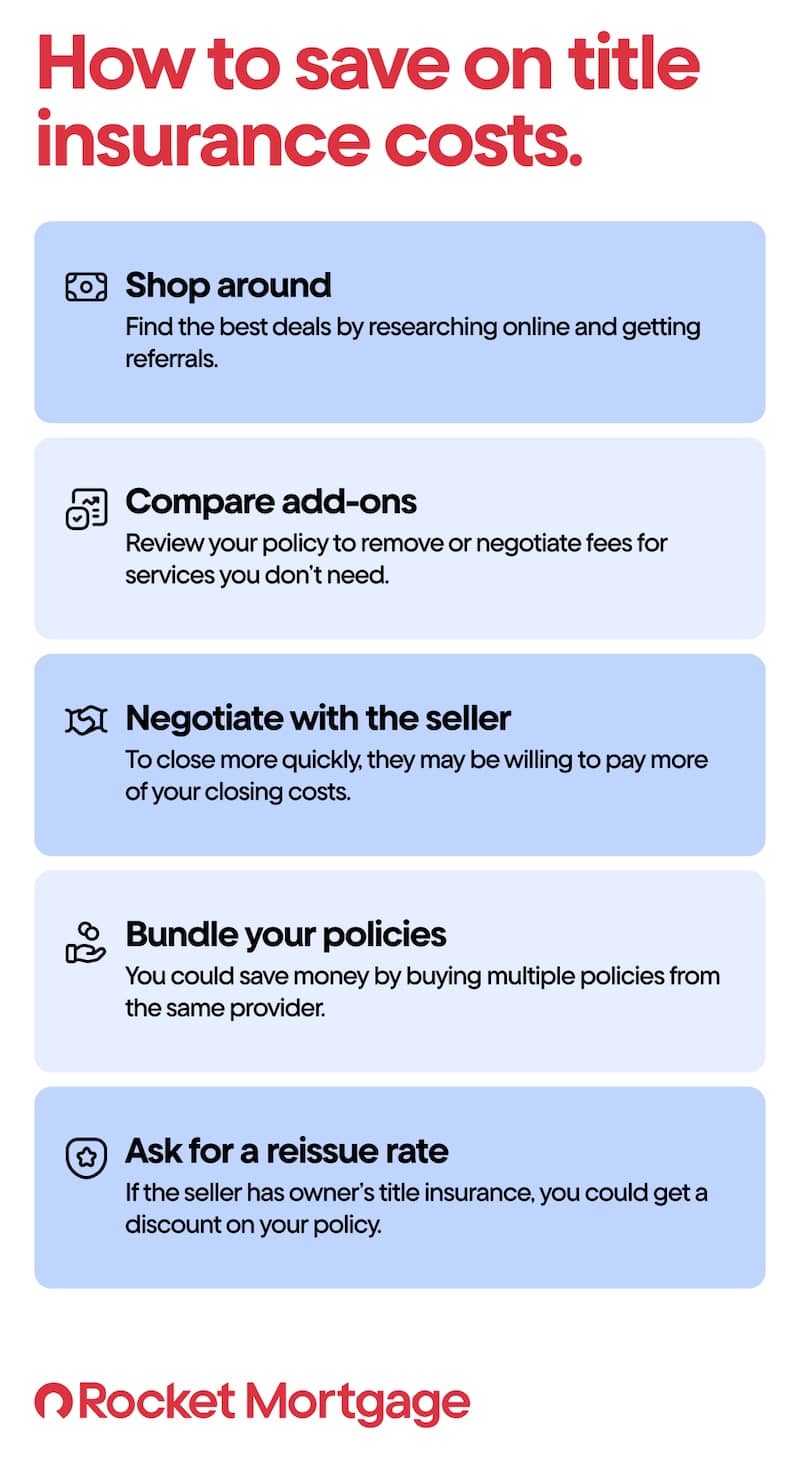
- Shop around: Compare the total cost of title insurance and settlement services from several providers when your lender allows you to choose. Your real estate agent or lender might provide referrals, but also look at independent quotes because a recommended provider may not offer the lowest overall cost or fit your needs.
- Compare the bottom-line total: Ask each provider for an itemized quote that includes the premium, title search, settlement fee and any document, wire, courier or other service charges. A lower premium doesn’t always mean a lower total bill.
- Negotiate seller-paid costs: You might be able to negotiate for the seller to pay some of your closing costs, including an owner’s title policy where local practice and your loan rules permit it. Include the concession in the purchase agreement and make sure that it falls within your mortgage program’s limits.
- Ask about a bundled discount: When an owner’s and lender’s policy are issued at the same closing, the combined premium can be lower than purchasing each policy separately. Ask whether simultaneous-issue pricing is available and how it affects your total cost.
- Ask about a reissue rate: A previous title policy on the property could qualify you for a reduced rate on a new policy. Eligibility varies, and you may need a copy of the seller’s policy or other proof that prior coverage existed.
Not every discount or shopping strategy is available in every state, so ask the title company which rates are fixed and which fees or discounts can vary.
FAQ
What is the average cost of title insurance?
Combined lender's and owner's title insurance and settlement services on average cost about 0.67% of the home's purchase price, according to ALTA and Fannie Mae. On a $300,000 home, that's roughly $2,000. A recent study by Urban Institute found that title insurance fees ranged from around $350 – $3,500 for a midpriced home, though your actual cost depends on your state and title company.
How is Florida title insurance calculated?
Florida is a promulgated rate state. The Florida Office of Insurance Regulation sets the owner's policy premium at $5.75 per $1,000 of coverage for the first $100,000, then $5 per $1,000 above that. Every licensed title company in Florida must charge this same rate. For example, on a $300,000 home, that works out to $575 for the first $100,000 plus $1,000 for the remaining $200,000, for a total premium of $1,575.
Is title insurance included in your closing costs?
Yes. Title insurance is disclosed as part of your closing costs on your Closing Disclosure, which your lender provides before closing under CFPB rules.
Do I have to use a specific title company?
In most cases, no. Your lender may recommend a title company, but you typically have the right to choose your own. In states without promulgated rates, shopping around for a title company can affect your final cost.
The bottom line: Title insurance can provide crucial protection when you purchase a home
Most homeowners will never file a title insurance claim. But for a one-time cost that often runs less than 2% of your purchase price for both policies combined, you're buying protection against exactly the kind of problem a title search doesn’t always catch – a forged signature, a missed heir, or an unpaid tax from years ago – which can cost tens of thousands of dollars, or even your home, to resolve.
A strategic move before closing is to know which costs are fixed, what’s optional, and where you have room to negotiate or shop around. A quick conversation with your title company or real estate agent about bundling, reissue rates, and seller-paid costs can lower what you pay, even in a state where the premium itself is fixed.
If you’re still planning your home purchase, getting preapproved with Rocket Mortgage can help you understand your loan options and estimate how much cash you may need at closing.
Rocket Mortgage is a trademark of Rocket Mortgage, LLC or its affiliates.
Ashleigh Potter
Ashleigh Potter is a PNW-based content writer at Rocket Mortgage and Redfin with more than five years of experience in digital marketing, content, and editorial strategy. She aims to help readers understand the nitty-gritty of home buying, selling, and lending – so big topics feel a little less overwhelming.
Related resources
10-minute read
Title insurance: What you need to know
Tiitle defects can create costly problems long after you've completed your home purchase. Learn how title insurance can help protect you and your lender.
Read more

6-minute read
What are title fees, and how much are they?
A home's title shows who has ownership and property rights. When you buy a new home, title fees cover the cost of the title search and related expenses.
Read more

5-minute read
What does a title company do?
A title company is a third party that works on behalf of both the lender and the buyer. Learn more about what title companies do in the home buying process.<...
Read more