First-time home buyer tax credit: What’s available now
Contributed by Maggie McCombs
Updated Aug 31, 2026
•10-minute read


There are no broadly available first-time home buyer tax credits available at the federal level, but state and local resources are available. Learn more about different forms of assistance and the types of qualifications you can expect.
Key takeaways:
- There’s no federal first-time home buyer tax credit currently available, but state and local programs may be available to you.
- Programs may have different requirements for who qualifies as a first-time home buyer, as well as income and other restrictions you’ll have to meet.
- You also may qualify for down payment assistance and government-backed home loans with little to no down payment requirement.
What happened to the first-time home buyer tax credit?
About 16 years ago, a tax credit of up to $8,000 was available to those who were purchasing their first home. This ended in 2010. It was intended as an emergency stimulus when the housing market was struggling during the financial crisis.
While several similar bills have been proposed by lawmakers to create new tax benefits for first-time buyers, none has become law.
See what you qualify for
What is a first-time home buyer tax credit?
A first-time home buyer tax credit is one aimed at improving home affordability for eligible first-time home buyers.
There’s a difference between credits and deductions. A tax credit is a dollar-for-dollar amount that taxpayers claim on their tax return to reduce the income tax they owe. The government uses tax credits to encourage taxpayers to do things like buy a home.
Who qualifies as a first-time home buyer?
While the phrase “first-time home buyer” might seem self-explanatory, different programs have different definitions.
To give you an idea, here are the requirements Rocket Mortgage has for loan programs aimed at first-time home buyers:
- You haven’t owned a primary residence in the last 3 years.
- You’re a single parent who has only owned a property with a former spouse while married.
- You’re a displaced homemaker who has only owned property with a spouse.
- You’ve only owned a primary residence not permanently affixed to a permanent foundation.
- You’ve only owned property that wasn’t in compliance with the state, local, or model building codes and it can’t be brought into compliance for less money than it would cost to build a permanent structure.
Take the first step toward the right mortgage
Apply online for expert recommendations with real interest rates and payments
Who qualifies for first-time buyer help?
Now that we know what a first-time home buyer is, who can actually qualify for help?
Do you have to be a true first-time buyer?
This depends on the program. In some cases, it may be necessary for this to be the first home you ever bought. In other cases, you may just be prohibited from having an interest in a home within a certain number of years.
Income and purchase-price limits
Sometimes the programs are targeted at low-to-moderate-income borrowers or have purchase-price limits. Check with the provider involved to see if these limits apply and what they are.
Get approved to buy a home
Apply online for expert recommendations and to find a solution that works best for you
Can you get taxes back as a first-time home buyer?
Whether you take a deduction or a credit, you’re not really getting taxes back. You’re reducing the amount you owe in taxes, either by getting a direct discount with a credit or reducing your taxable income with a deduction.
The exception to this is if the credit is fully refundable, meaning that you can get the full amount of the credit above and beyond what you owe in taxes. The only other situation involves an amended return with a bigger refund.
Tax deductions for first-time home buyers
It’s important not to confuse tax credits with tax deductions. While a credit is a one-for-one reduction of your tax bill, a deduction reduces your taxable income.
For example, a $500 deduction means that if your original taxable income is $60,000, your taxable income after the deduction would be $59,500. While your taxes may be reduced, they won’t necessarily be $500 less.
Homeowners can claim several tax deductions. We’ll cover the federal ones here, but your state or city may offer more.
- Mortgage interest deduction: If you’re buying a home today, you can deduct the interest on mortgage balances up to $750,000 if married and filing jointly, or $375,000 each if married and filing separately. If your home was purchased prior to April 1, 2018, the limit is $1 million for joint filers and $500,000 if you’re a married couple filing separately.
- Property tax deduction: You can deduct local property taxes from your federal return. If you itemize, state and local property taxes may be deductible as part of the overall state and local tax deduction. For tax years 2025 through 2029, the general limit is $40,000, or $20,000 if married filing separately, although the limit may be reduced for higher-income taxpayers. Consult a tax professional for the rules applicable to your tax year.
- Loan origination fee deduction: You can deduct points paid for the cost of originating your mortgage. In most cases, you must deduct this cost over the life of the loan instead of all at once in the year of your purchase. Consult a tax advisor on your situation.
- Mortgage points deduction: You might buy discount points from your lender when you take out a mortgage. You’ll pay an up-front fee in exchange for a lower interest rate on your loan. If a homeowner meets certain criteria put forth by the IRS, they can typically deduct the cost of the discount points as interest when filing taxes.
Residential energy credits
Federal residential energy credits were available for certain qualifying improvements placed in service through December 31, 2025.
Under current law, the Residential Clean Energy Credit and Energy Efficient Home Improvement Credit generally aren’t available for property placed in service after that date.
Homeowners should verify whether any federal, state, or local incentives are available before beginning a project.
How the old home buyer credit worked
There were a couple of different nationally enacted first-time home buyer credits enacted in the late 2000s as Congress hoped to boost the economy following the financial crisis.
|
Law |
Housing and Economic Recovery Act of 2008 |
American Recovery and Reinvestment Act of 2009 |
Worker, Homeownership, and Business Assistance Act of 2009 |
|
Time frame for purchase |
April 8, 2008 – January 1, 2009 |
January 1, 2009 – November 6, 2009 |
November 6, 2009 – July 1, 2010 |
|
Who could use |
First-time home buyers |
First-time home buyers |
First-time and repeat home buyers |
|
First-time home buyer credit |
10% of purchase price up to $7,500 |
10% of purchase price up to $8,000 |
10% of the purchase price up to $8,000 |
|
Repeat home buyer credit |
N/A |
N/A |
10% of the purchase price up to $6,500 |
|
Repayment needed |
$500 per year over 15 years following 1-year grace period |
Generally, no scheduled repayment, although recapture could apply if principal-residence requirements weren’t met. |
Generally, no scheduled repayment, although recapture could apply if principal-residence requirements weren’t met. |
|
Phaseouts |
MAGI above $75,000 ($150,000 for joint filers) |
MAGI above $75,000 ($150,000 for joint filers) |
MAGI above $150,000 ($225,000 for joint filers) |
|
Assistance income limits |
$95,000 MAGI ($170,000 for joint filers) |
$95,000 MAGI ($170,000 for joint filers) |
$170,000 MAGI ($245,000 for joint filers) |
To be considered a first-time home buyer, you and your spouse had to not have had an ownership interest in a principal residence in the last 3 years. Later, repeat buyers were added based on certain qualifications. The credit was to be used toward a primary residence.
Current programs that can lower your costs
While there is no broadly available federal residential purchase credit, there are other options for first-time home buyers looking for assistance.
Mortgage credit certificates (MCC)
State housing finance agencies can work with the federal government to convert some of their funding into mortgage credit certificates (MCC). These allow low- to moderate-income Americans to claim a credit for a portion of the mortgage interest they pay each year. The calculation is a little complicated, so speak with a tax expert if you have any questions.
Down payment assistance
Most types of mortgage loans require a down payment, which is a percentage of the home’s purchase price that you pay upfront. Fortunately for those who are purchasing their first home, a variety of down payment assistance options exist for first-time buyers, including loans and grants.
- Down payment assistance loans: Certain types of loans including second mortgages, deferred payment loans and forgiven loans can reduce the amount you have to put down on a house.
- Down payment assistance grants: Grants that are designed to assist first-time buyers with their down payment don’t have to be repaid.
It’s a good idea to check with your local or state government for details on any down payment assistance programs since eligibility requirements can vary. Additionally, make sure your mortgage lender will accept the assistance before you accept it.
Government-backed home loans
First-time home buyers who are hoping to make a low down payment or find a loan they can qualify for with lower credit might take interest in a government-backed home loan. There are three options, including FHA loans, VA loans, and USDA loans.
- FHA loans: Backed by the Federal Housing Administration (FHA), FHA loans allow eligible borrowers with a credit score of 580 to take out a mortgage with a 3.5% down payment.1,2
- VA loans: Courtesy of the Department of Veterans Affairs, VA loans provide affordable housing opportunities to qualified service members, veterans and surviving spouses. These loans have flexible credit score requirements and don’t require a down payment.3
- USDA loans: Designed for eligible home buyers in rural areas, some U.S. Department of Agriculture (USDA) loans don’t require a down payment on a home purchase. Rocket Mortgage doesn’t offer USDA loans at this time.
State-sponsored assistance
States sometimes offer assistance programs to help their residents achieve homeownership. It’s a good idea to research what may be available in your area. A good place to start is the directory of local home buying programs maintained by HUD.
HUD assistance
The Department of Housing and Urban Development (HUD) offers a variety of homeownership assistance to those looking to purchase a home. One of the biggest things they can help first-time home buyers with is housing counseling. This involves taking a hard look at your financial situation to know how much you can afford and whether you’re ready to move forward.
Borrow from an IRA or Roth IRA
If you have a traditional or Roth individual retirement account (IRA), you would typically pay a 10% penalty in additional taxes on any IRA withdrawal you make before age 59 ½. However, there’s an exemption that may benefit first-time home buyers.
Qualifying first-time home buyers can take out up to $10,000 of distributions penalty-free to buy, build, or reconstruct a first home.
For the purposes of this section of the tax code, a first-time home buyer is defined as anyone who hasn’t owned a primary residence in the 2-year period leading up to the acquisition of the home. Also, you must use the funds to purchase or build the home within 120 days of withdrawal.
Although there’s no additional tax penalty, the distributions you take are subject to regular income tax regulations. Speak with a tax advisor about your situation.
Loan from employer-sponsored plans
In addition to the IRA carveout, it’s legal for your employer to offer loans out of retirement accounts they sponsor. The IRS says you can borrow up to 50% of your vested account balance or $50,000, whichever is less.
Normally, the loan from your retirement plan must be paid back within 5 years with a minimum of quarterly payments. However, you may be able to pay off the loan over a longer period if you use the money to buy a primary residence.
You’ll want to be careful with this. If you leave the company, the terms of your loan may call for immediate repayment. Additionally, if you don’t make payments, it may be treated as an early distribution. If you take the money before age 59 ½, it may be subject to a 10% tax penalty in addition to regular income taxes.
How to claim home buyer tax benefits
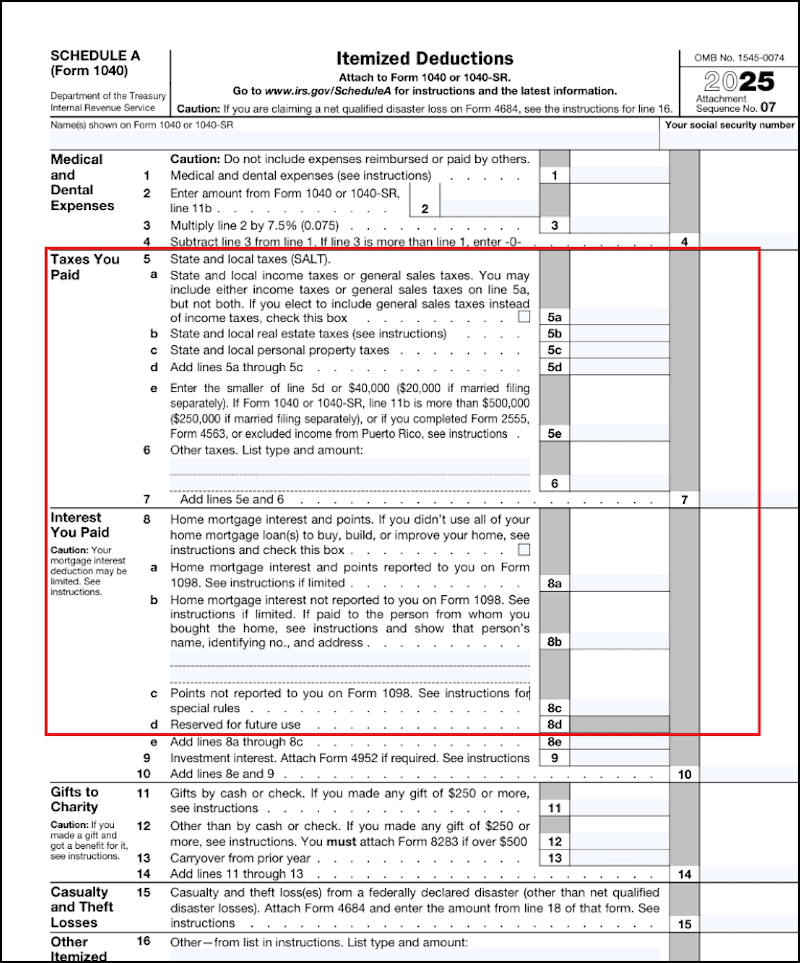
To claim benefits for home buyers, you have to itemize deductions rather than take the standard deduction. Every tax situation is different, so speak with an adviser to help with the math on what makes the most sense.
If you do itemize deductions, the lines pertaining to homeownership are in the Schedule A screenshot below:
FAQ
Below are some common questions about tax breaks for new home buyers.
How do I know if my state offers first-time home buyer tax credits?
We recommend checking the website for your state taxing authority to find any information on home buyer tax credits or homeownership deductions that may be available to you.
What’s the difference between a tax credit and a tax deduction?
A tax credit and tax deduction can both reduce your tax bill, but they do so in different ways. A tax credit is a dollar-for-dollar reduction on the tax that you owe. A tax deduction, on the other hand, reduces your taxable income.
How does a tax credit work for first-time homeowners?
A tax credit reduces the amount of income tax first-time homeowners owe when they file their taxes. While there isn’t currently a tax credit for first-time buyers in place, there are a variety of tax deductions and other assistance programs first-time buyers can benefit from.
What is the IRS definition of a first-time home buyer?
Definitions can change depending on the part of the tax code you’re reviewing. For the purposes of the allowance for IRA withdrawals without penalty for first-time home buyers up to $10,000, a first-time home buyer is someone who has had no interest in a primary residence in the 2 years leading up to the purchase.
Does Florida have a first-time home buyer credit?
Although there are other programs available, there is no first-time home buyer tax credit for Floridians.
Why did the $8,000 home buyer tax credit end?
The first-time home buyer tax credits cost in the wake of the late 2000s financial crisis were intended to provide temporary economic stimulus and help stabilize the nation’s housing market. After a few extensions and revisions, the provisions ran their course.
The bottom line: There is no current national first-time home buyer tax credit
There is currently no first-time home buyer tax credit available at the federal level. However, that doesn’t mean there aren’t options available in your state. States can also issue mortgage credit certificates that can be used to lower income taxes dollar-for-dollar. Be sure to ask your mortgage lender for suggestions as well.
Additionally, deductions can lower your tax liability, even if they don’t do so on a one-to-one basis. Finally, you can look at everything from state-sponsored assistance to taking out a retirement plan loan. Especially if you choose to go the latter route, consult a tax expert.
If you’re ready to think about financing, start your mortgage application online.
1Rocket Mortgage is not acting on behalf of FHA or HUD.
2To qualify for this offer, you must meet all standard FHA eligibility requirements. In addition, your total mortgage payment, including taxes and insurance, cannot exceed 38% of your income, your debt-to-income (DTI) ratio cannot exceed 45%, and you must have 12 months of verifiable housing history immediately prior to your application, no late payments 30 days or greater in the last 12-months, and no derogatory marks on your credit report. Not available on jumbo loans. Asset statements may be needed, no more than 1 day of non-sufficient fund fees are allowed in the most recent 2 months prior to application. Additional restrictions/conditions may apply.
3Rocket Mortgage is a VA-approved lender, not endorsed or sponsored by the Dept. of Veterans Affairs or any government agency.
This article is for informational purposes only and is not intended to provide financial, investment, or tax advice. You should consult a qualified financial or tax professional before making decisions regarding your retirement funds or mortgage.
Rocket Mortgage is a trademark or service mark of Rocket Mortgage, LLC or its affiliates.
Kevin Graham
Kevin Graham is a Senior Writer for Rocket. He specializes in mortgage qualification, economics and personal finance topics. Kevin has passed the MLO SAFE exam given to mortgage bankers and takes continuing education courses. As someone with cerebral palsy spastic quadriplegia that requires the use of a wheelchair, he also takes on articles around modifying your home for physical challenges and smart home tech. He has a BA in Journalism from Oakland University.
Related resources
5-minute read
First-time home buyer classes: A guide
A first-time home buyers class can help you understand and prepare for the experience. See what you can expect from a class as a first-time home buyer.
Read more

7-minute read
The costs of buying a house that first-time home buyers should prepare for
There are many ongoing and up-front costs associated wit...
Read more

7-minute read
Down payment assistance programs: What they are, and how they work
Learn how down payment assistance programs work, who qualifies, and where to find grants or loans that can help with upfront home buying costs. Start here.
Read more